Cybercrime 2026: what INTERPOL’s hard facts and latest global report show – and why partnerships are decisive
In a world where cybercrime is no longer a “lone individual at a keyboard” but a highly industrialised, cross-border ecosystem, INTERPOL provides clear figures and a clear call to action.
When I recently analysed the transcript of an exclusive presentation by the head of the Cybercrime Directorate at the INTERPOL Global Complex for Innovation (IGCI) in Singapore, one thing became particularly clear: the fight against cybercrime only works through genuine, cross-sector partnerships. Here are the hard facts – straight from the presentation and the latest official INTERPOL report.
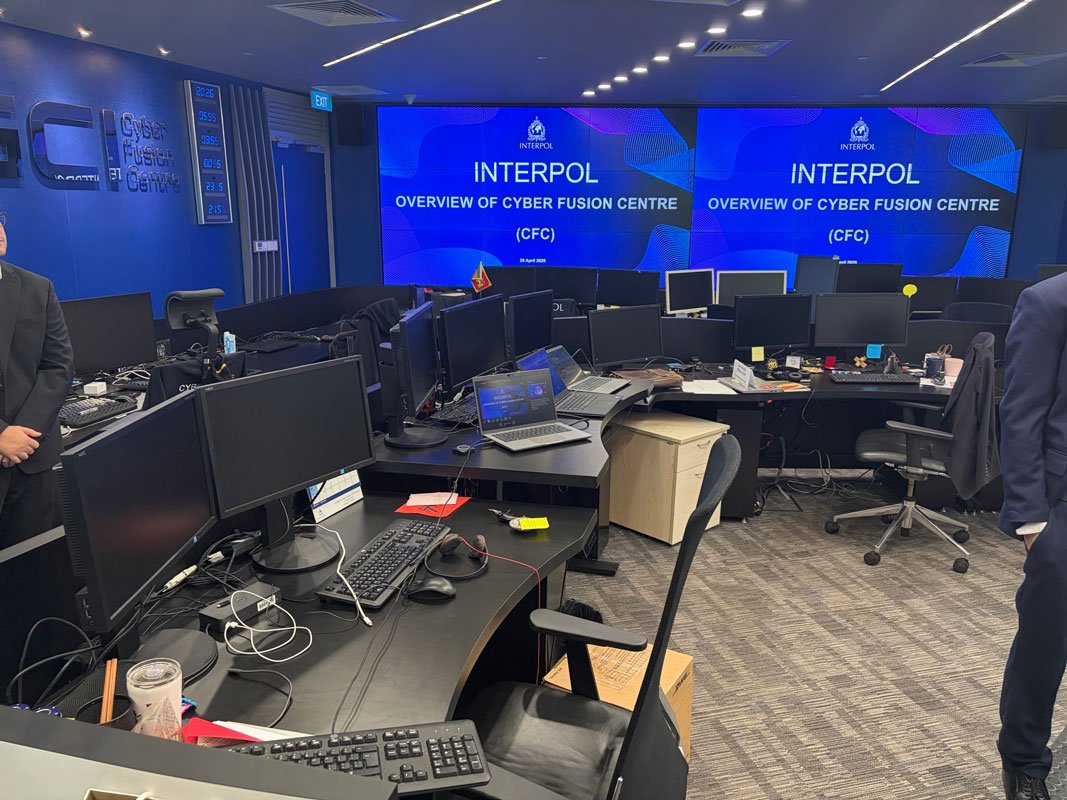
The Cyber Fusion Centre (CFC) at the INTERPOL Global Complex for Innovation, Singapore
Hard facts on INTERPOL and cybercrime (as of 2026)
- 196 member countries – the largest police network in the world.
- The Cybercrime Directorate is the only one of the four major crime areas (cyber, organised & emerging crime, financial fraud, counter-terrorism) based entirely in Singapore – strategically placed in Asia’s tech hub.
- Three core teams (intelligence/fusion centre, capabilities & strategy, operations) work hand in hand with private partners through the unique Gateway programme.
- A record year in 2025: more operations than ever before – including the first large-scale Asia-only operation, Operation Secure, against infostealer malware (26 countries, with 200,000 potential victims identified in a single country).
Key findings from the latest INTERPOL report
The basis is the “INTERPOL Global Financial Fraud Threat Assessment 2026” (March 2026) and the parallel Operation Synergia III (July 2025 – January 2026):
- Global financial fraud losses in 2025: USD 442 billion – a figure consistent with the broader cybercrime estimate (losses equivalent to the world’s third-largest GDP after the US and China).
- AI as a game changer: phishing campaigns are 4.5 times more likely to be clicked when AI is used. AI-assisted fraud is estimated to be 4.5 times more profitable than traditional methods. According to the presentation, around 80 % of all hackers already use AI in their workflow.
- Industrialisation and the scam centre model: the model that originated in South-East Asia (human trafficking + phishing-as-a-service + residential proxies + bulletproof hosting) is spreading rapidly to the Americas, Europe and Africa. Criminal organisations outsource the technical part and scale massively.
- Operation Synergia III: 72 countries, 94 arrests, more than 45,000 malicious IP addresses and servers taken down – across phishing, malware and ransomware.
The report makes it clear: cybercrime is no longer just “digital”. It is poly-criminal – closely linked to organised crime, human trafficking and even terrorist financing. Behind the billions are real victims who lose their livelihoods.
What this means for Austria and Europe
Even well-prepared countries like Austria benefit enormously from INTERPOL’s global intelligence network (Cyber Activity Reports, CARs). At the same time, we can contribute best practices (such as Singapore’s Anti-Scam Shield) and expert knowledge to the Cyber Expert Working Group (180 specialists).
Takeaways from Singapore

Visiting the IGCI in Singapore, April 2026
“As law enforcement, we cannot do everything alone – partnerships are the decisive force.”
This is exactly what INTERPOL puts into practice with Gateway, its fusion centres and regional projects such as Stardust (residential proxies & bulletproof hosting), Harpoon (anti-phishing) and Horizon (AI-enabled cybercrime).
For everyone working in cyber security, finance or public authorities: the threat is real and growing exponentially. But the solution lies in global, trust-based cooperation.
Would you like a more in-depth analysis of the transcript or the full report? Get in touch.